- Introduction of Computer (कम्प्यूटर एक परिचय)
- What Is Computer ( कम्प्यूटर क्या है) ?
- History & Generations इतिहास और पीढ़ियाँ
- Advantage And Disadvantage of Computer- कंप्यूटर के लाभ और हानियाँ
- The Motherboard – मदरबोर्ड
- CPU- सी.पी.यू.
- Types of Computers -कम्प्यूटर के प्रकार
- Evolution of Computers & its applications
- Latest IT Gadgets- आईटी गैजेट्स
- Input Devices
- Output Devices
- Computer Memory and storage कम्प्यूटर मेमोरी एवं स्टोरेज
- Software – सॉफ्टवेयर्स
- Basics of Hardware & Software
The word “Computer” is derived from the Latin word “Compute,” which means “to calculate.” In the early days, computers were viewed strictly as mathematical tools. However, in the modern era, the definition has expanded. Today, a computer is not just a calculator; it is a sophisticated electronic device that handles everything from high-end graphics and music to global internet connectivity.
कम्प्यूटर शब्द की उत्पत्ति लैटिन शब्द ‘कम्प्यूट’ (Compute) से हुई है, जिसका शाब्दिक अर्थ है “गणना करना”। शुरुआत में, कम्प्यूटर को केवल गणितीय गणनाओं के लिए एक उपकरण माना जाता था। लेकिन आज की परिभाषा बदल चुकी है। अब कम्प्यूटर केवल गणना तक सीमित नहीं है; यह एक ऐसा उन्नत इलेक्ट्रॉनिक उपकरण है जो संगीत, ग्राफिक्स, इंटरनेट और जटिल डेटा प्रोसेसिंग जैसे कार्यों को आसानी से कर सकता है।
1. Technical Definition / तकनीकी परिभाषा
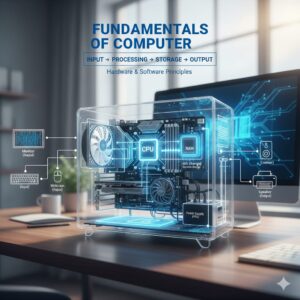
Technically, a computer is an Electronic Device that accepts raw data as input from the user, processes it using a set of instructions (Software), and produces a meaningful result known as Information (Output).
तकनीकी रूप से, कम्प्यूटर एक इलेक्ट्रॉनिक डिवाइस है जो यूजर से कच्चे डेटा (Raw Data) को इनपुट के रूप में स्वीकार करता है, निर्देशों के समूह (सॉफ्टवेयर) के माध्यम से उसे प्रोसेस करता है, और एक सार्थक परिणाम प्रस्तुत करता है जिसे हम सूचना (Information) या आउटपुट कहते हैं।
2. The Data Processing Cycle (IPO Model) डेटा प्रोसेसिंग चक्र (IPO मॉडल)
Data vs. Information:
Data: Raw facts like “10, 20, +” (meaningless on its own).
Information: The processed result “10 + 20 = 30” (meaningful).
To function, every computer follows a specific step-by-step processing cycle: कम्प्यूटर कार्य करने के लिए एक निश्चित स्टेप-बाई-स्टेप प्रक्रिया का पालन करता है:
- Input (इनपुट): It accepts data and instructions from the user through devices like a keyboard or mouse. (यह कीबोर्ड या माउस जैसे उपकरणों के माध्यम से यूजर से डेटा और निर्देश स्वीकार करता है।)
- Processing (प्रोसेसिंग): The CPU (Central Processing Unit) manipulates the data based on the instructions provided. It performs both arithmetic (math) and logical (decision-making) operations. (सी.पी.यू. दिए गए निर्देशों के आधार पर डेटा में फेरबदल करता है। यह अंकगणितीय और तार्किक दोनों तरह की गणनाएं करता है।)
- Output (आउटपुट): After processing, the result is presented to the user on a screen (Monitor) or paper (Printer). (प्रोसेसिंग के बाद, परिणाम को स्क्रीन या कागज पर यूजर के सामने प्रस्तुत किया जाता है।)
- Storage (भण्डारण): It can store data permanently for future use. (यह भविष्य में उपयोग के लिए डेटा को स्थायी रूप से स्टोर कर सकता है।)
3. Key Characteristics of a Computer
कम्प्यूटर की प्रमुख विशेषताएँ
- Why is the computer so essential today? Here are its core strengths: आज के समय में कम्प्यूटर इतना महत्वपूर्ण क्यों है? यहाँ इसकी मुख्य विशेषताएं दी गई हैं:
- Speed (गति): Computers can perform millions of calculations in a fraction of a second. (कम्प्यूटर एक सेकंड के हजारवें हिस्से में लाखों गणनाएं कर सकता है।)
- Accuracy (सटीकता): It never makes mistakes. If the input is correct, the output is always 100% accurate. (यह कभी गलती नहीं करता। यदि इनपुट सही है, तो आउटपुट हमेशा सटीक होता है।)
- Storage (भण्डारण): It can store massive amounts of data in a very small space. (यह बहुत कम जगह में भारी मात्रा में डेटा स्टोर कर सकता है।)
- Versatility (बहुमुखी प्रतिभा): One machine can do many things—type a letter, play a game, or design a building. (एक ही मशीन कई काम कर सकती है—पत्र लिखना, गेम खेलना या किसी इमारत का डिजाइन बनाना।) Diligence (कर्मठता): Unlike humans, a computer does not get tired or bored. (इंसानों के विपरीत, कम्प्यूटर कभी थकता या ऊबता नहीं है।)
4. Hardware and Software: The Two Pillars
हार्डवेयर और सॉफ्टवेयर: दो मुख्य आधार
A computer is a combination of two major parts: कम्प्यूटर दो प्रमुख भागों का मेल है:
- Hardware (हार्डवेयर): The physical parts that you can see and touch (CPU, RAM, Monitor). (वे भौतिक भाग जिन्हें आप देख और छू सकते हैं।)
- Software (सॉफ्टवेयर): A collection of programs that tell the hardware what to do (Windows, Photoshop, Browsers). (प्रोग्रामों का समूह जो हार्डवेयर को बताता है कि क्या करना है।)
5. Modern Applications / आधुनिक उपयोग
Today, the use of computers has reached every corner of our lives: आज कम्प्यूटर का उपयोग हमारे जीवन के हर कोने में पहुँच गया है:
- Education (शिक्षा): Online classes and digital research. (ऑनलाइन कक्षाएं और डिजिटल रिसर्च।)
- Business (व्यवसाय): Managing accounts and global trade. (खातों का प्रबंधन और वैश्विक व्यापार।)
- Entertainment (मनोरंजन): Music, movies, and high-end gaming. (संगीत, फिल्में और गेमिंग।)
- Science (विज्ञान): Space exploration and weather forecasting. (अंतरिक्ष अन्वेषण और मौसम का पूर्वानुमान।)